Showing posts with label Silent Eagle. Show all posts

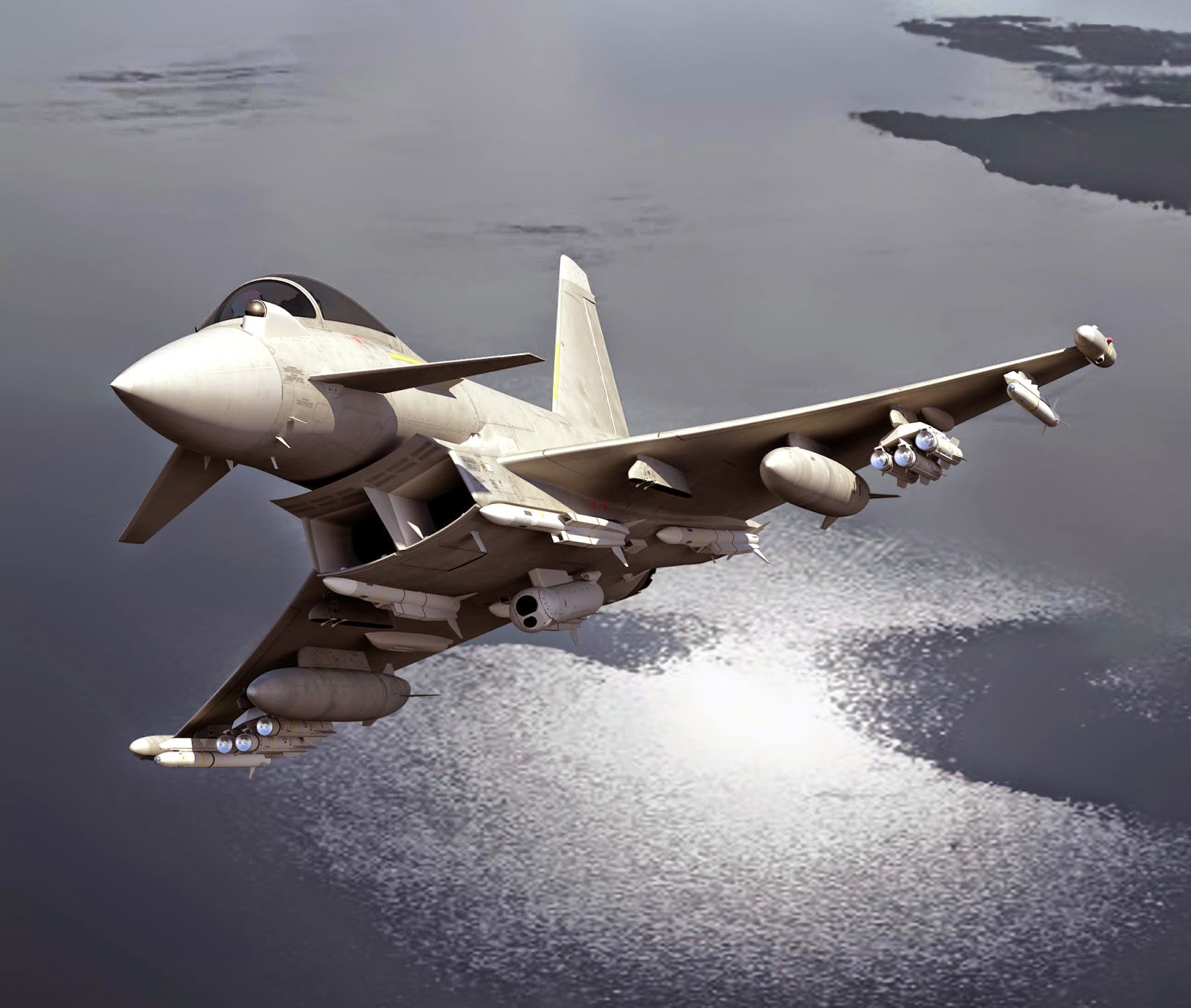
Fighter Jet Fight Club: Typhoon vs. Silent Eagle!


When the UK, Spain, Germany, and Italy got together to design the Eurofighter Typhoon, one wonders why they simply did not decide to procure the F-15 Eagle instead.  Instead, they decided to to go one better and develop a new medium-sized multirole fighter.  In theory, this had the benefit of both producing a fighter for the 21st century (hence the "Eurofighter 2000" moniker) as well as keeping the European aerospace industry up to date.

Did they succeed?  In a word...  Yes.  But not without difficulty.  The Typhoon program has been beset with cost overruns, maintenance issues, and dissent among the partner nations.  Much of this is due to simple timing.  With the Cold War ended, many questioned the need for a cutting edge fighter. In recent years, economic concerns have led to austerity measures.  Now, the Eurofighter partners are looking for foreign buyers to help breath new life into the Typhoon.

The F-15 had no such issues.  As the USAF's "golden child" it has received plenty of funding and upgrades over the years.  Plenty of foreign sales have resulted in the F-15 becoming the "big stick" of western airpower.  Its undefeated combat record speaks volumes, and when F-22 production was cut short, the mighty Eagle has continued its air-superiority role.

The Eagle's halcyon days are coming to an end, however.  The USAF sees the F-35 as its future, with the F-15 taking more of a supporting role.  Boeing would very much like to keep the Eagle flying, so it has come up with a "last hurrah" variant in an attempt to keep production going just a little longer.

Both of these aircraft have been overshadowed by newer "5th generation" fighters, but how do they compare with each other?

Once again, here are the rules.

Air-to-ground:  

Interdiction/Penetration:  The Typhoon was designed with an eye towards reducing its RCS.  This was done by using lots of non-metallic materials in its construction.  It also uses plenty of active countermeasures, like towed decoys and the like.  It is not a "stealthy" aircraft, but it does not light up enemy radar like a Christmas tree, either.

The Silent Eagle has been thoroughly "stealthified" by adding radar absorbent material, internal weapon carriage, and a few other tricks.  This only works from the front aspect however.  From the sides and from the back, the F-15SE is still rather unstealthy.  

Since ground radar is likely to first see an approaching aircraft from the front aspect, the F-15SE has an edge here.  Advantage:  F-15SE

Deep Strike:  When it comes to range, both fighters make out quite well.  Both have options of conformal fuel tanks or external drop tanks.  

The F-15SE is a bigger fighter, however, able to carry more fuel both internally and externally.  It also has the advantage of being one of the first fighters to utilize CFTs.  Its system has been well proven whereas the Typhoons is still in development.  Advantage:  F-15SE

Payload:  This category has almost always worked out in the Silent Eagle's favor, and today is no different.  The Silent Eagle, like the Strike Eagle it is based on, is big fighter-bomber in the same category as the FB-111 and others.  No surprise here.

The Typhoon does carry up to 16,500lbs worth of bombs, but that is only enough to beat out the smaller Gripen.  Against the 23,000lbs payload of the F-15SE, it is simply outclassed.  Advantage:  F-15SE

Close air support:  Let us be clear, neither of these aircraft would make for good close air support were it not for targeting pods.  Without them, these aircraft would be playing "best guess" from over 30,000ft with 500lb bombs.  Not exactly optimal when troops on the ground are "danger close".  

With the targeting pods, these aircraft have a much better chance of putting its ordinance where it needs to be.  But what about the ordinance itself?  With the addition of low-collateral damage Brimstone missiles, the Typhoon can take out targets effectively without the blast radius of bigger bombs or missile like the AGM-65 Maverick or even the GBU-39 Small Diameter Bomb.

Sometimes, it is preferable to drop a bullet with the bad guy's name on it instead of a bomb inscribed "to whom it may concern".  Advantage:  Typhoon

Air to ground winner:  There really should not be much of a surprise here.  While the F-15 may have started out as a "not a pound for air-to-ground" fighter, it has evolved into a potent strike aircraft.  The Typhoon simply does not have the Silent Eagle's size advantage, nor RCS reduction measures.  Winner:  F-15 Silent Eagle

Air to air:

First look, first kill:  From the front, the Silent Eagle keeps a low profile with its missiles tucked away inside it conformal weapon bays.  It also happens to have a huge AESA radar tucked under that huge nosecone.  This low RCS profile drops with the angle of approach, as the F-15SE is still very much an F-15 when viewed from the sides.

The Typhoon keeps its BVR missiles external but they are not exactly hanging in the breeze.  They are stored conformally to reduce drag and radar cross section.  In its nosecone, the Typhoon mounts a CAPTOR-E AESA radar that is similar in size to the F-15SE's.  The CAPTOR-E has the extra benefit of a rotating mechanism that gives it a wider field of view, however.

The Typhoon likely has inferior RCS from the front.  It has a distinct advantage from the sides thanks to its swiveling radar, however.  This big advantage here more than makes up its disadvantage from the sides, giving it the nod here.  It is close, however.  Advantage:  Typhoon

Beyond visual range:  The F-15 has become a legend with its over 100-0 win/loss record in air to air combat.  Many of these victories were beyond visual range.  Keeping that in mind, we realize that the F-15SE truly is the one to beat here.

The Typhoon seems up to the task however.  Not only does is mount a slightly better radar, but it mounts the MBDA Meteor, aka the "next big thing" in BVR missiles.  The Typhoon does not have the same Mach 2.5 top speed as the Eagle, but does have a faster climb rate and a the ability to supercruise.  Top speed is a nice gauge of fighter performance, but it really is academic as achieving that speed wastes fuel.  While the Typhoon can engage at Mach 1.5, the Eagle would be spending most of its time subsonic with several "sprints" breaking the sound barrier.

With a slightly better radar, better missiles, and a higher "real world" speed, the Typhoon wins this one.  Advantage:  Typhoon

Within visual range:  After fighters like the F-4 provided disappointing BVR performance over Vietnam, fighters like the F-15 went "back to basics" with a renewed emphasis on WVR combat.  The F-15 is highly maneuverable with a fantastic power to weight ratio.  The Silent Eagle adds HMDs and an IRST to make high-off-boresight (HOBS) missile targeting a snap.

The Typhoon has a similar HMD and IRST set up.  On top of that it is an absolute demon in close-combat with a higher thrust-to-weight ratio, lower wing loading, and a control canard setup that allows for near-instantaneous changes in pitch.  The Typhoon happens to be smaller as well.

The F-15SE is no slouch in WVR combat, but the Typhoon simply better.  Advantage:  Typhoon

Dogfight:  The F-15SE is bigger, tougher, and carries a lot more ammo for its 20mm vulcan cannon.

The Typhoon is smaller, more agile, and carries a bigger gun (27mm) with less ammo.

I am not exactly sure how these two would fare against each other.  What I do know is that such a confrontation would be epic.  Advantage:  Tie

Air to air winner:  The F-15 started out as a strictly "not a pound for air-to-ground" air-superiority fighter.  Through the years, it has evolved into a very respectable bomber.  In doing so, its air-to-air prowess has become less of a priority.  While fighters like the Su-35 have gotten thrust vectoring and other features to improve performance, the F-15 has to make do little more than an AESA radar upgrade.

The Typhoon has kept its focus on air-superiority with strike capability secondary.  Thrust vectoring is being studied for it, but some believe it is not even needed given its already impressive performance.  Add impressive missiles like the Meteor to the mix and you have a true world-beater.  Need more proof?  Two words:  "Raptor Salad".  Winner:  Typhoon

Versatility/Logistics:

Versatility.  If you are looking for a carrier-capable fighter, look elsewhere.  Do you need STOVL capability?  Move along.  Do you need a dedicated EW platform?  Nothing to see here.  These fighters are capable of air-to-air combat and air-to ground combat.  That is it.  

The Silent Eagle does have its limited "stealth" configuration, and it does have a slightly better selection of ECM pods like the AN/ALQ-131(V).  The Typhoon has more options when it comes to weapons, however, capable of carrying the IRIS-T, ASRAAM, and other non-American ordinance.

Neither of these aircraft really knock it out of the park.  Advantage:  Tie

Logistics:  The F-15 is found in use all over the world, as well as the largest standing air force, the USAF.  Its cost and complexity keep it from being a ubiquitous as the F-16 however.  Thankfully, avoids "hangar queen" status like the F-22, but it really is only usable by large air forces with big budgets.  Adding "stealth" to the equation likely results in more maintenance headaches.  

The Typhoon is a little easier to live with, but not much.  It is the preeminent fighter for most of Europe, but parts shortages and high operating cost have been worrisome.  It does require a shorter runway than the F-15SE, and it does use less fuel.  

Again, neither of these aircraft stand out enough to declare a winner.  Advantage:  Tie

Versatility/Logistics winner:  Both fighters can perform air-superiority and strike roles, but that is about it.  They also have a few challenges when it comes to operations.  While this will not concern militaries with lots of resources, it would likely be a challenge for those with smaller ambitions.  Winner:  Tie


Final Result:

Air-to-ground:  Typhoon = 1  -  Silent Eagle = 3
Air-to-air:  Typhoon = 4  -  Silent Eagle = 1
Versatility/Logistics:  Typhoon = 2  -  Silent Eagle = 2

Final Score:  Typhoon = 7  -  Silent Eagle = 6

Both of these aircraft are very good at what they do.  Out of the aircraft competing in Fighter Jet Fight Club, the Silent Eagle is possibly the best strike platform.  The Typhoon is likely the best air-superiority platform.  Neither of them really stand out in versatility and logistics however.  

Therein lays the cold, hard reality of aircraft design.  While newer technologies have allowed for designs that perform a myriad of roles, compromises still need to be made.  There is no "perfect" multirole fighter.  Sooner or later concerns about weight and cost come into play, and there is often no repealing the laws of physics or economics.  

The Typhoon gets the nod hear because it is a better fighter to the F-15SE's better bomber.  Both are damn good, however.  There really is no "loser" here...  On the condition that a force can afford to operate and support these expensive fighters.

Only one more FJFC to go...  Let me know what you think!
Published: By: Unknown - 7:17 AM

Fighter Jet Fight Club: Super Hornet vs. Silent Eagle!


Like many of you, I grew up in the shadow of an older sibling.  That older sibling always seemed to be so much better at everything.  Everything just sort of fell in place for him.  High school was a breeze, followed by university, followed by a prestigious and high-paying job.

My story was a little different.  I was the awkward kid in high school, flunked out of university, than wandered around from one low-paying job to another until I finally got my act together.  By the time I did, by older brother was already living in a nice house, driving a fancy sports car, and dating one beautiful woman after the other.

In retrospect, it was all about timing.  My brother was born 10 years before I was, giving him an ample head start.  He graduated university at a time when a diploma was all you needed to land a high-paying job (even a Bachelor of Fine Arts).  The economy was good and everybody was hiring.

I was not so lucky.  Intent on challenging myself, I chose the more difficult courses in high school:  Honors math, chemistry, physics, and biology.  Yeah...  Science, bitch.  While I kept my grades up in high school, university ended up being a disaster.  Needless to say, calculus and alcohol do not mix.  For the next few years, I kept stumbling around trying to find my path.  Finding work was a challenge, and a 5-year foray into journalism proved fruitless.  By the time I finally "found myself" in a career in emergency medicine, my older brother was well set on his life's path, getting job promotions and doing quite well for himself.

I bring up this sibling rivalry because it reflects the fates of Boeing's (formerly McDonnell Douglas) fighter offerings.

The F-15 Eagle has always been the favored son.  Put simply it was the air-superiorty fighter of the 1970s and 1980s.  While the F-14 may have co-starred in a Tom Cruise blockbuster, it was more of an interceptor and it just did not match the F-15's international sales success (with one exception).  Even today, after the F-14 has long been retired, the Eagle lives on, not just as an air-superiority fighter, but a strike fighter as well.  Cancellation of F-22 Raptor production means the F-15C will still be relevant for the foreseeable future.  With the development of the F-15SE Silent Eagle, Boeing hopes to continue producing Eagles for years to come.

By contrast, the F/A-18 Hornet has taken a while to find itself.  First developed as the YF-17 Cobra, it was passed over in favor of the YF-16 Fighting Falcon for the USAF's Lightweight Fighter (LWF) program.  Luckily, the United States Navy was in need of a light multirole fighter to supplement its F-14.  The Cobra would live on as the F/A-18 Hornet.  Later, cancellation of the A-12 Avenger II and retirement of the F-14 left the USN with another large gap to fill.  Still reeling from the recession of the 1990s, the Pentagon opted for a low risk solution of "upsizing" the F/A-18 Hornet.  This led to the F/A-18E/F Super Hornet.

To this day, the F-15 continues to be more successful than its younger sibling.  Many air forces passed over the original Hornet in favor of either the more intimidating Eagle or the cheaper Fighting Falcon.  Even now, Boeing is struggling to find buyers to keep the Super Hornet assembly line running.

So how do these sibling measure up to each other?

[NOTE:  While I may have forgone the "Advanced Super Hornet" in previous FJFC installments, doing so would seem unfair here.  Neither aircraft is operational, nor does either have any guarantee of production.  I am willing to bend the rules a little this time.  There is still no information on how a Super Hornet with GE414-EPE engines would perform, so please bear with me.]

Air-to-ground:

Interdiction/Penetration:  Boeing has been hard at work trying to lower the RCS of the Super Hornet while it is carrying additional fuel and weapons.  While the CFTs and enclosed weapon pod (EWP) seen on the Advanced Super Hornet do not lower RCS compared to a an unladen Super Hornet, they certainly would compared to a Super Hornet carrying drop tanks and external missiles all mounted on pylons.  It helps that the Super Hornet was designed with RCS reduction in mind.  Then again, Boeing will be offering a "hybrid" Super Hornet that mounts the electronic warfare receivers from the EA-18G Growler.  This would assist in avoiding enemy defenses.  

While the F-15's basic design comes from a time when "stealth" was of little concern, Boeing has done all it can to reduce the Eagle's RCS in the F-15SE.  Conformal weapon bays keep ordinance hidden from prying radar eyes, and liberal application of RAM (radar absorbent material) has driven down the F-15's RCS just about as far as it can go.

So which one is stealthier?  Even with EWPs, the Super Hornet is still hanging stuff off of it, resulting in increased radar return.  The F-15SE's stealth modifications have focused on reducing frontal RCS, with much less attention places on other aspects (doing so would likely require a full redesign).  With too much guesswork involved regarding both aircraft, let us just call it even.  Advantage:  Tie

Deep Strike:  When Boeing super-sized the F/A-18 into the Super Hornet, one of the biggest payoffs was range.  When the Advanced Super Hornet's CFTs are added, this range increases even further (about 1000km).  With long range ALCMs like the AGM-158 JASSM-ER available, the Rhino will have no trouble reaching its target.  

Range has never been much of a problem of the F-15.  It was one of the first applications of CFTs (formerly known as FAST packs), allowing for extra fuel without much extra drag.  With the F-15SE, these CFT's have been converted to CWB's, but the ability to mount CFTs remains.  There is also a similar weapon selection to the Super Hornet, so reach is likely to never be an issue.

When it comes to range, both fighters should be considered to have more than enough.  About the only way to improve on either aircraft's range is to implement a long range bomber instead.  Advantage:  Tie

Payload:  The other major improvement the came about from the F/A-18's growth spurt is the ability to carry far more ordinance.  Not only could the Super Hornet carry almost two tons more worth of weapons (17,750lbs total), but it could bring more of those weapons back to the carrier and land safely.  Oddly enough, this came at a slight price.  "Separation issues" (i.e. bombs bumping the aircraft after release) forced engineers to mount the weapon pylons at a 3° outward angle.  It is hoped that the EWPs will help mitigate this somewhat, but the fact remains that "maxed out" Rhino will have to fight substantial drag.  

Not that it matters compared to the Silent Eagle.  The F-15SE should be able to carry anywhere from 23,000lbs to 26,000lbs (depending on the source).  Some of these weapons can be stored internally, eliminating drag.  

The F-15SE has the clear win here.  Advantage:  F-15SE

Close air support:  Precision guided munitions are all the rage these days.  Some say that dedicated CAS aircraft like the A-10 are quickly becoming obsolete.  Why should an aircraft fly low and expose itself to ground fire when it can fly above the clouds dropping laser and GPS guided bombs?  Thankfully, the Super Hornet can do both these things.  With the proper ordinance and a targeting pod, it can rain down "death from above" without ever exposing itself.  When the situation calls for it, the Rhino can fly low and slow, putting the "Mark One Eyeball" on the target.  Praised for its low-speed, high AoA performance, the F/A-18E/F makes a darn good CAS platform.

The Silent Eagle has similar ground pounding capabilities as the Super Hornet at high altitudes, but the F-15 was never meant to fly slow and low enough to land on an aircraft carrier.  The F-15SE is just out of its element at low altitudes.  It is a rugged aircraft, sure, but it really was meant to fly fast and high.

While the Super Hornet is comfortable flying low-and-slow or high-and-fast, the Silent Eagle really would prefer just to stay away and play sniper.  Advantage:  Super Hornet

Air-to-ground winner:  Both aircraft are impressive when it comes to the strike role.  The only real difference is that the F-15SE is more of a heavy bomber while the Super Hornet does better supporting ground troops.  You really cannot go wrong with either one, however.  Winner:  Tie

Air-to-air:

First look, first kill:  Neither is truly a "stealth" fighter, yet both have been thoroughly "stealthified". It would be hard to say which one has a true advantage when it comes to reduced RCS.  The F-15 likely has a slightly higher IR signature, thanks to its massive P&W F100-229 turbofans.  Both aircraft will incorporate built-in IRST sensors.  

Whatever similarities the two might have regarding stealth are thrown out the window when comparing radars.  The Super Hornet just does not have the roomy nosecone of the Eagle, despite both fighters being similarly sized.  Both aircraft use the same processor, but the dish on the F-15SE is about 50% larger.  

With everything else being more or less equal, this one goes to the one with the bigger radar.  Any advantage the Super Hornet might have in the IR spectrum would be academic by comparison.  Advantage:  F-15SE

Beyond visual range:  There is nothing really wrong with the Super Hornet as an air-superiority fighter, but there is nothing really impressive about it either.  Most agree that the USN lost some of its air-superiority capability when it retired the F-14.  Some even suggest that the USN upgraded the wrong fighter.  Even with a performance boost provided by uprated GE414-EPE engines, the Super Hornet will never be capable of the F-15's raw power and speed.  

No one has ever criticized the F-15's air superiority capability.  Quite the contrary.  With an undefeated 100-0 win/loss record in air-to-air combat, the Eagle has nothing to prove.  The F-15SE flies faster, higher, and maneuvers better than the Super Hornet.  Not only can it give its AMRAAMs more energy, but its larger radar makes locking on to the target a snap.  

Not only does the Silent Eagle have some clear advantages over the Super Hornet, but the F-15 Eagle family has the reputation to back it up.  Advantage:  F-15SE

Within Visual Range:  Things get a little more even as the aircraft get closer together and top speed becomes less of a factor.  Both aircraft are quite proficient at "turning and burning".  Both aircraft are equipped with HMDs and the ability to fire HOBS missiles, in this case, the AIM-9X Sidewinder.  

Both aircraft have roughly the same power-to-weight ratio, but the Silent Eagle capable of slightly better g-loading.  The Eagle also boasts of better time-to-climb and wing loading.  The Super Hornet does have a superior nose authority, however, allowing it to point its Sidewinder at target more quickly.

The Silent Eagle starts out with a slight advantage here, only to lose that advantage to the Rhino as things get slower and tighter.  Advantage:  Tie

Dogfight:  Both of these rugged aircraft are built tough.  Tough enough that it would likely take more than a lucky hit with either aircraft's 20mm M61 Vulcan cannon to take the other out.  

If both aircraft have converged into a "furball", the Super Hornet's nose authority really starts to give it a clear advantage.  Not only that, but the Rhino handles much easier at slow speeds than the high-strung F-15.  If that was not enough, the Super Hornet just so happens to hold more ammo than the Silent Eagle as well.

Where the Eagle was meant to fly high in the clouds, the Hornet prefers to buzz around closer to the ground.  In a close quarters knife-fight, the F/A-18E/F has a clear edge.  Advantage:  Super Hornet

Air-to-air winner:  The F-15 was first envisioned as an air-superiority fighter with "not a pound for air-to-ground".  It was only later that it was found out that the Eagle makes a pretty darn good strike fighter, as well.  By contrast, the Super Hornet was a budget-friendly attempt to replace two vastly different aircraft (the A-6 and F-14) resulting in an impressive, but still compromised design.  Winner:  F-15SE

Versatility/Logistics:

Versatility:  Once again, the Super Hornet scores an easy win in the versatility department.  Carrier capable?  Check.  Two-seater version?  Check.  Electronic warfare version?  Check.  Electronic warfare-light version?  Likely check.  Aerial tanker?  Check.  AEW&C version?  Maybe someone is working on it as we speak.

The F-15SE is a little more...  Simple.  While there are plenty of different F-15 variants (F-15C, F-15J, F-15SG, F-15K...), these all boil down to one of two archetypes:  Air Superiority (F-15C) or Strike Fighter (F-15E).  Sadly, a F-15G "Wild Weasel" was never meant to be.  The Silent Eagle is a strike fighter.  It strikes and it fights.  What more could you want?

The Super Hornet's "Jack-of-all-trades" capability once again secures the nod in this category.  Advantage:  Super Hornet

Logistics:  Former US president Bill Clinton once said:  "When word of crisis breaks out in Washington, it's no accident the first question that comes to everyone's lips is: where is the nearest carrier?"  Super Hornets are already deployed all around the world in service with the USN.  Their "no frills" design has made them reliable, dependable, and easy to maintain.  It is said to be even easier to maintain than the older, less capable legacy Hornets.

Boeing has stuck with marketing the Silent Eagle only to nations that already use a F-15 variant of some kind.  This speaks volumes.  Without existing infrastructure, it seems likely that the F-15SE would be too much trouble for new buyers to operate.  The F-15 requires long runways and all the fixin's at its home base.  The F-15E's cost per flying hour is roughly 50% more than the Super Hornet, the Silent Eagle's RAM coating would likely only make the disparity even larger.

While the Super Hornet seems ready to do anything and go anywhere, the Silent Eagle comes across as somewhat of a diva.  Advantage:  Super Hornet

Versatility/Logistics winner:  While the Silent Eagle may be more impressive in the air, the Super Hornet proves itself easier to live with on the ground.  Not only that, but it is up for just about anything.  It really does put the "multi" in multirole fighter.  Winner:  Super Hornet


Final score:

Air-to-ground:  Super Hornet = 2  -  Silent Eagle = 2
Air-to-air:  Super Hornet = 2  -  Silent Eagle = 3
Versatility/Logistics:  Super Hornet = 2  -  Silent Eage = 0

Final Result:  Super Hornet = 6   -  Silent Eagle = 5

WHAT?  

Thus far, the Super Hornet has yet to win an installment of FJFC.  The Silent Eagle has yet to lose.  How did this happen?

In a word, balance.  The only role that the F-15SE would have a clear advantage over the Super Hornet is that of air-superiority.  Yet the Super Hornet is just as capable in the strike role, and offers the capability to perform other roles as well.  It should be noted here as well that the "Advanced" features of the "Advanced Super Hornet" (CFTs, EWPs, and increased engine power) had very little effect on the final outcome.  At most, the score would have been tied.

Not that it matters here, but the Super Hornet is far more affordable as well.  

Like the F-15SE, I'm pretty sure my older brother would win in a fair fight against his younger sibling.  He also has a nicer house and earns a larger paycheck.  That does not make him superior however.  It is merely the result of a singular drive to succeed at one's job path.  He seems to have little free time, no real hobbies, and takes life far too seriously.  Like the Super Hornet, I stylize myself as a bit of "Renaissance man", capable and knowledgeable in areas that have no bearing on my career, but I find it rewarding nonetheless.  I make time to do the things that I enjoy, and I'll be damned if I can't laugh at things, least of all myself.

Besides all that, I'm pretty sure Mom always did like me best


Published: By: Unknown - 10:32 AM

Speculating on the Saab/Boeing T-X

Boeing T-X concept (pre-Saab partnership)
Saab and Boeing dropped a bombshell late last year when they announced that they would be joining forces to submit a bid for the upcoming T-X program.  The T-X program intends to replace the venerable T-38 Talon in use by the USAF as a high performance jet trainer.  

What will this collaboration look like?  Early reports on a "decontented" Saab Gripen have been dispelled.  This will be an "all new" aircraft.  Given the context of the T-X program, it is very likely that much of the project will be off-the-shelf in order to keep risk and costs down.  

Designing an all new aircraft does give put the Saab/Boeing T-X bid in a riskier position than the other T-X contenders.  All the other bidders are proposing existing aircraft in order to keep risks to a minimum.  Lockheed Martin is partnering up with Korean KAI in offering the T-50 Golden Eagle, Northrop Grumman is partnering with BAE in offering the Hawk T2/128, and Alenia Aermacchi is offering the M-346 Master.  

Looking at the other contenders, the Lockheed Martin/KAI T-50 is the obvious front-runner.  It is a fairly new design and a fine performer by the looks of it.  It certainly does not hurt to have Lockheed Martin's massive marketing behind it either.  The BAE Hawk is a 40-year-old design, not to mention subsonic.  It is a fine trainer, but it is hard to imagine it being relevant for another 30-50 years.  The M-346 Master is an underdog.  Not only does it lack Lockheed or Boeing's marketing push, but the design is based on the Russian Yak-130.  Needless to say, this could render the design unpalatable in today's political climate.  

Saab and Boeing would likely be able to get away with going a similar route as the competition.  The Gripen is little more "high end" than the others, but a JAS 39D with a cruder radar, no weapon systems, and perhaps a more generic GE F404 engine replacing the Volvo RM12 would bring costs down.  Boeing's mighty manufacturing prowess combined with economies of scale would do the rest.  

Too easy?
So why are Boeing and Saab taking the risk of an all new design?  

Perhaps the risk is not as bad as it seems.  There is already some trepidation about Lockheed Martin being the only fighter manufacturer in the USA.  Not only does it raise concerns financially, but strategically as well.  Yet when Boeing ceases production of the F/A-18E/F Super Hornet and F-15 Eagle within a few years, this will be the case.  The idea of buying hundreds of foreign designed aircraft as fighter-trainers only emphasizes this.  Producing an "all new" aircraft of American heritage actually gives Boeing a considerable political advantage.

Another factor is the possible disadvantage held by the front-runner, the KAI T-50.  Lockheed Martin backing may actually backfire as issues continue with the F-35.  There are rumors that problems and delays with the Northrop B-2 did little favors for the YF-23 Black Widow when it lost to the Lockheed Martin YF-22.

Issues with the F-35 may have another benefit for Saab and Boeings upcoming T-X contender.  As costs go up and problems arise, some have questioned the possibility of an alternative.  At the very least, there may need to be a lower cost option to supplement a smaller-than-expected JSF fleet.  A cheaper, simpler aircraft would also likely make sense for the Air National Guard or for tasks like aggressor training.  

In short, Boeing and Saab may be taking this opportunity to design a trainer...  That could be a lot more than a trainer.  

First and foremost, Boeing and Saab will have to present an affordable and adaptable trainer capable of replacing the T-38 Talon.  This entails several things:
  • Affordability is a priority.  Not just in procurement, but in operation.
  • Risk must be kept to an absolute minimum.  
  • This aircraft will prepare pilots for the F-22, F-35, NGB, and "6th generation" aircraft not even conceived yet.  
  • There is a high likelihood of the T-X being used as a "companion trainer" to allow pilots to keep their flight hours up without flying expensive aircraft like the F-22.
  • Adoption of a "aggressor" trainer seems likely.
  • The T-X will likely see many upgrades and modifications over the years to remain relevant.  
  • While the T-X is a USAF project, the USN is involved, and further sales are likely.  
While 350 aircraft would be enough to replace the T-38, there is the potential demand here for 1000 or even more aircraft.  Certainly well worth the risk.  

With all that in mind, let us peer into the crystal ball...

General Layout:


Boeing's unsuccessful (and ugly) X-32
Since risk needs to be minimized, it is likely that both Boeing and Saab will go for what they know.

Saab certainly prefers the single engined delta wing.  Its last two fighter designs, the JAS-39 Gripen and the J-37 Viggen were both delta/canard layouts.  Before that, the J-35 Draken was a cranked or "double delta" design.

Boeing likely has mixed feeling towards the delta layout.  Its unsuccessful JSF contender, the X-32 started out as a delta-wing design.  Built as a single piece, this large delta wing would have provided for large internal fuel capacity and reduced drag.  It proved difficult to manufacturer, however, and changes in the performance required by the USN resulted in a change to a more conventional (yet still ugly) design.  Before finalizing the more conventional layout, a pelikan tail was considered to reduce drag and improve stealthiness.  Boeing opted against this, however.

Nope.  Still ugly.
At the very top of this post, you will notice a picture of a Boeing T-X concept that was released before it announced its partnership with Saab.  While the T-38 and F-18 influences are obvious, the pelikan tail seems rather conspicuous.  The tail not only mimics that of the YF-23 Black Widow, but McDonnell Douglas/BAE/Northrop Grumman's JSF proposal.  While the T-X has no need to be a true stealth aircraft, it likely would not hurt for it to be a "stealthier" aircraft.  Not only would a pelikan tail allow for this, but the decreased drag would result in lower fuel consumption as well.

A pelikan tail does have disadvantages.  Since it uses two larger control surfaces instead of four smaller ones, it requires beefier hydraulics to move them.  In the X-32's case, that would have added up to 900 pounds to an aircraft already pushing its weight limits thanks to a STOVL requirement.  This extra weight would be less consequential on a CTOL-only trainer, however.

Saab's FS2020 concept model
Perhaps the "all-new" design already exists.  Saab has shown its own Flygsystem (Flight System) 2020 that envisions an indigenous stealth aircraft for the Swedish Air Force.  This FS2020 concept looks very much like a "stealth" Gripen with a pelican tail.

Looking at the FS2020, the McDonnell Douglas JSF, and Boeing's T-X concept art reveals a clear direction.  The Boeing/Saab T-X will likely be a single-engined delta-winged aircraft with a pelikan tail.  Perhaps Saab's influence will lead to it incorporating canards, possibly to mitigate the extra size and weight required for the pelikan tail.

The FS2020 concept, or something close to it, could very well be the chosen design.  It has already undergone some wind-tunnel and sub-scale testing.

Engine:

General Electric F414 turbofan.
The Saab/Boeing T-X will almost undoubtedly be a single-engine design.  A single engine reduces maintenance and fuel costs.  There would seem to be little benefit in going with a twin-engine design.  

The choice of engine can be easily narrowed down.  Both Saab and Boeing currently use derivatives of General Electric's F404 and F414 turbofans.  The legacy Hornets use the F404 while the Gripen thus far uses the Volvo RM12 which is heavily based on the same.  Both manufacturers use the F414 on their newer Super Hornet and Gripen NG designs.

Given that the F414 is a newer design that may even be offered on the KAI T-50, which currently uses F404s, it seems likely that the GE F414 will be the default engine choice on the Saab/Boeing T-X.

Cockpit:

Advanced Super Hornet cockpit mock-up.
It is quickly becoming apparent that "all-glass" cockpits are here to stay.  First seen in the F-35, large touch screens are now being promoted for updated versions of the Gripen, Super Hornet, and Silent Eagle.  This is not just a trend, it is the future.  These reconfigurable touch screens not only prioritize important information, but they can quickly change depending on the mission type.  Upgrades are also made easier, as a simply software patch can improve the man/machine interface.  

For a next generation trainer, the "all glass" cockpit offers additional advantages.  Displays could have several "skins" that more closely resemble that of trainee's intended aircraft.  Not only that, but flight software could also be modified to make the T-X perform like other aircraft.  This could include (but not limited to) restricting afterburner use, g-limits, or controlling stick inputs.  In essence, this would be giving the T-X a set of virtual "training wheels".

Sensors:

Saab Gripen E's AESA radar and IRST.
The current USAF trainer, the T-38 Talon, goes without IRST or even a radar.  Its avionics package merely includes rudimentary flight sensors, navigation, and communication equipment.  It would seem likely that the T-X will have little need for either as well.  A data-link of some sort would likely be the most important upgrade, as this would help prepare pilots for the advanced data links found in the F-22 and F-35.  

The "base model" T-X has little need for a radar or IRST, but it is likely that space will be available for such.  This gives Boeing and Saab more leeway in adopting the T-X into a combat ready fighter.  At the very least, it makes the T-X a more tempting candidate for use as an "Aggressor" trainer.  USAF aggressor trainers are already being outfitted with IRST pods to better mimic potential adversaries.  

More advanced sensors, like the F-35's DAS and EOTS systems, seem unlikely.  Not only do they add additional cost and complexity, but their value on a training system would be dubious.  Like the radar and IRST, this may be another item that will not be standard issue, but space is available for future upgrades.  

Weapons:

F-15SE's conformal weapon bay (CWB)
As a trainer, even as an aggressor, the T-X will have little need for weapon storage.  At most, a handful of pylons would be needed for mounting items like targeting pods and the like.  Internal weapon storage would be completely unnecessary and would only serve to increase development risk with no real payoff.

But...  What if I told you there was a way for Boeing and Saab to add internal weapon storage?  Not only that, but this method would be nearly risk free, as it has already been tested.

Boeing has been hard at work lately finding ways of making its legacy fighters stealthier.  It has self-funded development work on both the F-15E and the Super Hornet, finding ways to mount weapons and extra fuel without the RCS penalty.  Boeing has modified the F-15E Strike Eagle's CFTs (formerly known as FAST packs) into conformal weapon bays (CWBs) on the F-15SE Silent Eagle.  

Advanced Super Hornet's Enclosed Weapon Pod

Similar work has been done on the F/A-18E/F Super Hornet.  Not only does the "Advanced Super Hornet" mount two shoulder mounted CFTs, but it incorporates an "enclosed weapons pod" or EWP.  Like the F-15SE's CWBs, the EWP allows for stealthier weapon carriage without the need for a permanent cavity in the aircraft's structure.  This not only simplifies the design, but it saves weight, as the aircraft's structure does not have to be reinforced around the weapons bay.  As any mechanical engineer will tell you "holes can be heavy".  

Boeing has already tested the F-15SE's CWBs on a Strike Eagle test aircraft.  The concept works.  


Possibly the biggest advantage to a CWB or EWP is expandability.  A variety of different sized CWBs or EWPs can be made available, depending on the mission.  Larger pods could be used to house "bunker busters" or a large amount of smaller bombs, while a smaller pods could be used for air-to-air missiles.  

The real opportunity here for the Boeing/Saab T-X is for a design that is "custom built" to mount some sort of CWB or EWP.  Instead of being mounted these on a pylon or as an afterthought on the side of the aircraft, the Boeing/Saab T-X could have provisions for special "conformal weapons pods".  The most likely mounting points would be on either side of the fuselage, like the F-15SE, and possibly one flush with the bottom centerline of the fuselage, the the Super Hornet above (but without the pylon).

These conformal weapon pods could turn the unarmed T-X trainer into a full-fledged fighter.  Not only could they carry missiles and bombs, but they could carry other important items like a targeting pod or a cannon.  As time goes on and technology changes, new conformal weapon pods could be developed to allow new weapons without the need to modify the core aircraft.

This modular approach would have benefits for non-warfighting T-Xs as well.  Those conformal pods could be used to house camera equipment.  One of the T-38's most familiar roles was that of a chase plane.  The T-38 was not strictly a USAF aircraft, NASA was a user as well.  No doubt those conformal pods would be of use for them.  

Putting it all together.

McDonnell Douglas/BAE/Northrop Grumman JSF proposal
Boeing and Saab decided to develop an all-new aircraft for a reason.  It is difficult to imagine that they will simply aim for a dedicated trainer without any thought to a war fighting version.  All of the other T-X contenders have armed versions available, why should Saab and Boeing be left out?

Saab and Boeing's biggest ace in the hole is the F-35's increasing costs and delays.  While the JSF is certainly "too big to fail", it certainly is not "too big" to decrease the scope of the program.  Cuts to the JSF would free up a great deal of cash for other projects.

The Saab/Boeing T-X could be a sort of "back door" into providing a supplement, and perhaps an alternative to the F-35.  By producing a modular, upgradable design that does not have to constrain itself to the JSF's "do everything" mandate, Saab and Boeing might just deliver an aircraft that makes far more financial sense to those having second thoughts about the F-35.  

Here, take this.  It is a single grain of salt.
Please keep in mind that this is entirely conjecture on my part.  Saab and Boeing may have something else up their sleeve entirely, and I have no inside information from which to base any of this on.  Saab and Boeing have not revealed any details yet.  Their final design may incorporate some, none, or all these musings.

Who knows, there may even be more surprises when the final design is introduced.  
Published: By: Unknown - 7:13 PM

Fighter Jet Fight Club: Rafale vs. Silent Eagle


Comparing the aircraft in this weeks Fighter Jet Fight Club is a little bit like comparing the cuisine from their respective countries.

French cuisine tends to come across as more sophisticated.  The Rafale shares this trait.  It is a modern looking design that blends together the latest in technology, aerodynamics, and building techniques to construct an aircraft that is not only functional, but often praised for its aesthetic value as well.  Most would agree that the Rafale is indeed a fine looking airplane.  Presentation is quite important in French Haute Cuisine, after all.

By comparison, the F-15SE Silent Eagle is an all-you-can-eat buffet at Golden Corral.  It may not entice the most sophisticated of palates, but there is a little bit of everything there, and you certainly will not walk away hungry.  The F-15SE satisfies your hunger by dishing out generous helpings of whatever you happen to be in the mood for.

Before we take a look at the menus, remember the rules, and don't forget to tip your server.

Air-to-Ground:

Interdiction/Penetration:  Hors d'oeuvres are typically served before the meal, in the time between the guests arrive and the main course is served.  These bite-sized morsels are intended to stimulate the appetite while leaving room for the entree.  The Rafale's sophisticated SPECTRA electronic warfare suite uses a combination of systems to evade and disrupt enemy sensors.  

If the Rafale is a fancy hors d'oeuvre, than the F-15SE is basket full of spicy jalapeƱo poppers.  It certainly does not look intimidating, but that is because the excitement is contained inside the plain beige exterior.  By keeping its weapons inside its conformal weapons bays, the F-15SE reduces its RCS considerably.  The Silent Eagle also adds a little bit of sophistication to the mix, as it is also has the option of carrying electronic warfare equipment.

With the option to go fully into "stealth mode", the F-15SE wins this one.  Advantage:  F-15SE

Deep Strike:  A proper meal needs a proper beverage.  Instead of wine, the Rafale brings more than enough jet fuel to the party.  It also brings some rather impressive potent potables such as the SCALP EG ALCM.

If the Rafale brings a carafe full of bordeaux, than the F-15SE brings a Super Big Gulp full of Mountain Dew.  If that was not enough, its conformal fuel tanks act the same as a beer helmet, providing the Silent Eagle with plenty of liquid refreshment.  When it comes time to share, the F-15SE forgoes anything fancy.  Its AGM-158 JASSM ER is the equivalent of a hip flask full of Jack Daniels.  It goes anywhere, and it is sure to get the job done.  

With a longer range and the more potent ALCM, the Silent Eagle belches out a win here.  Advantage:  F-15SE

Payload:  French food is known of being decadently rich.  Lots of butter, sauce, and fat.  The Rafale echoes this.  Despite being a medium-size fighter, it carries a full-size payload. Able to carry 21,000lbs, it easily exceeds that of the similar sized Eurofighter Typhoon and F-35.  

The Silent Eagle represents America however.  It simply will not be outdone when it comes to portion sizes.  This is the country that invented the Supersized Double Bic Mac combo, after all.  The F-15SE is a full-sized fighter, yet even then its payload is a claimed 29,500lbs.  

The Rafale may be a five-course meal, but the F-15SE is an all-you-can-eat buffet.  Advantage:  F-15SE

Close air support:  For the close air support role, the Rafale is as attentive as a French waiter.  Able to fly low over your shoulder, it can help you with your menu selection of precision guided smart bombs.

By contrast, the F-15SE is the attendant at a drive-through window.  Flying high and fast it is more about convenience than personal service.  You will get your food, but it will be delivered at arms length and your server will be far away by the time you get to your meal.  

With its ability to stay closer to the troops, the Rafale wins this one.  Just be sure to tip.  Advantage:  Rafale

Air-to-ground winner:  The F-15SE can fly further, with a heavier bomb load, and it has the option of internal weapon storage to allow it access to well defended areas.  The Rafale is the better close-air-support aircraft, as it is better at flying low and slow.  This is not enough to make up for its disadvantage against the F-15SE, however.  Winner:  F-15SE Silent Eagle.

Air-to-Air:  

First look, first kill:  Proper french cuisine takes time and preparation.  Even the kitchen needs to set up in a certain way so that ingredients are accessible in the right order, at the right time.  French cooks call this mise en place.  It is known in English as "a place for everything, and everything in its place".  The Rafale echoes this.  Its various sensors give it a great view of the air space around it.  Its AESA radar is similar in size used by the Super Hornet and F-35.  Not huge, but just the right size.  The Rafale does have an impressive RCS, and its ability to supercruise means it can travel faster while keeping its IR signature down.  

If the Rafale is a well organized kitchen, the Silent Eagle is a big southern barbecue with an industrial sized deep-fat-fryer.  Its AESA radar is about 50% bigger than the Rafale's while presenting a smaller RCS.  Food is cooked fast simply because of high heat and a large grill.  The F-15SE pays a penalty however, as its IR signature is substantially higher than the Rafale's.  This is exacerbated by the Silent Eagle's need to use its afterburner to go supersonic.  

While the Silent Eagle plays a superior radar game, the Rafale has an advantage when it comes to IR. For this reason, I will call the aircraft equal.  Radar does have a longer range than IRST, but it can be jammed or evaded much easier.  Advantage:  Tie

Beyond visual range:  Finally, we get to the entree.  The Rafale has IR or RR guided MICA missiles, as well as the latest in haute cuisine, the MBDA Meteor.  Better still the, Rafale can fly high and fast to give those missiles a little bit of extra energy.  

The F-15SE has a reputation to uphold here.  Its larger radar should give it a clear advantage, but it is let down somewhat by its missiles.  The AIM-120D AMRAAM is a damn good missile.  Possibly the equivalent of a Five Guys double-bacon cheeseburger.  Not fancy, but it uses a two-way datalink to help find its target and a two-stage rocket to make sure it hits.

Its only weakness against the Silent Eagle here is its smaller radar, but that disadvantage becomes moot because it will need to get within the Rafale's sensor range (about 50-100km) in order to fire it.  The Rafale has the better missile (arguably, I know) with the Meteor but it lacks a two-way data link and the sheer size of the F-15SE's radar.  This one is too close to call.  Advantage:  Tie

Within visual range:  The Rafale has a tasty side dish of Mica missiles.  The big question here is whether or not it will be equipped with an HMD.  The Rafale has been tested with the TopSight HMD, but this has not been made operational nor are there any immediate plans.  Previous plans to adopt the Gerfaut HMD were shelved.  For now, the Rafale needs to rely on either its IRST or a data-link lock from another aircraft to fire HOBS missiles.  

The F-15 does have its usual array of familiar AIM-9 Sidewinders.  HMD has been on the F-15 for a while now, and the Silent Eagle will not be any different.  According the Boeing, the Silent Eagle will have an integrated IRST, a step up from the external pod on older models.  

Both aircraft are quite agile, with capable missiles and sensors.  If the Rafale has a HMD, then this is a case of Steak Frites vs Steak and fries.  Advantage:  Tie

Dogfight:  Sometimes you just have to put the knife and fork down and use your hands and teeth.  For this, the Rafale prefers to take bigger bites with it 30mm cannon.  The Silent Eagle takes small, 20mm nibbles by comparison, but it can do so for a lot longer with more ammo.

Rafale may have the slight edge here, being a more modern fly-by-wire design, but the F-15SE is no slouch.  It was designed to be a dogfighter thanks to lessons learned from the Vietnam air war.  It is also a tough dish to chew, with one F-15 making it safely home after losing a wing.

This one is another tie.  What the Silent Eagle lacks in agility, it makes up for in toughness.  Advantage:  Tie

Air-to-air winner:  The F-15SE may be Guy Fieri next to the Rafale's more sophisticated Julia Childs, but both are strong in flavor when it comes to aerial combat.  This one is a draw.  Winner:  Tie


Flexibility/Logistics:

Flexibility:  French cooking relies heavily on different seasoning.  A simple change in spices or sauces can completely change the characteristics of a dish.  The Rafale is no different, billed as an "omnirole fighter" the Rafale's mission can change dramatically simply by changing its weapon load out.  Air superiority fighter, maritime defense, recon, precision strike, even aerial refueling.  The availability of a carrier version adds even more depth.

By contrast, the Silent Eagle is simple salt (air superiority) and pepper (ground attack).  It fulfills these roles extremely well, but those looking for something more should look elsewhere.

KFC sells a lot of poultry, but good luck finding one that sells Foie Gras.  If you are looking for a varied menu of items, it is best to go French.  Advantage:  Rafale

Logistics:  French food is quite exclusive.  Only sparkling wine originating from a certain French province can all itself Champagne, and do not believe anyone trying to sell you a locally sourced Bordeaux.  The Rafale only uses genuine French ingredients, including Snecma engines and Thales radar.  Good luck finding those at your local Loblaws.  Thankfully French cooking is accessible to everyone, with plenty of cookbooks available.  Dassault has offered the same by offering Rafale customers its "cookbook" of intellectual property and technology transfer.  

While McDonalds may not be the epitome of fine dining, there is a pretty good chance you live within a half-hour's drive from one.  The F-15 may not be the McDonalds of jet fighters (that would be the F-16) but it should be considered at least the Burger King.  F-15 customers all over the world have had it there way by ordering regional specific variants like the F-15I (Israel), F-15SG (Singapore) and F-15J (Japan).  American defense contractors are quite tightlipped regarding military technology, however.  The F-15SE's "secret blend of herbs and spices" will likely stay that way to the customer.  Advantage:  Tie

Flexibility/Logistics winner:  The Rafale performs a lot more roles and requires less fuel and runway to operate.  The F-15SE has a more accessible parts chain.  The Rafale ultimately wins this one, however, as Dassault's willingness to "open source" the Rafale gives it a slight edge here.  Winner:  Rafale


Final Score:

Air-to-ground:  Rafale=1  -  Silent Eagle=3
Air-to-air:  Rafale=4  -  Silent Eagle=4
Flexibility/Logistics:  Rafale=2  -  Silent Eagle=1

Final Result:  Rafale=7  -  Silent Eagle=8

The sophisticated Rafale may be more refined, but the Eagle offers a healthier portion smothered with cheese and bacon.  Both aircraft are excellent at what they do, but the F-15SE comes out by concentrating on the basics.  Foie Gras and sweetbreads may not be to everyone's tastes, but just about everyone can enjoy some BBQ ribs with a side of corn on the cob...  Unless you are a vegetarian.

Had your fill?  Got a bone to pick?  Want to chew me out?  Fill out the comment card below.

[NOTE:  Please keep your comments related to the F-15SE or Rafale.  Repeated mentions of other fighters will be deleted.  All of you Gripen and Super Hornet fans should have it out of your system after last week!]


Published: By: Unknown - 6:50 PM

Fighter Jet Fight Club: F-35 vs. Silent Eagle!


In this week's edition of FJFC we look at a classic scenario pitting an up-and-coming star against a grizzled old veteran.  The Lockheed-Martin F-35 is the new kid in town, looking to make a name for itself.  A product of the Xbox generation, this kid played Call of Duty on a plasma screen, not Cops and Robbers in the backyard.  While its being promoted as "the next big thing" in fighter aircraft, many remain unimpressed. Some say that it has only gotten this far due to "friends in high places" and a few greased palms.

Unlike the new kid, many think the F-15 Eagle's best days are behind it.  Despite many years as the reigning champion, it has been surpassed by another prizefighter, the F-22.  This, despite the fact that the F-22's fights have all been fixed and real challengers ignored.  Some even say that the F-22 has issues that make it impossible to work with.

The F-15 has not been sitting idly by, however.  The Boeing Bruiser keeps going to the gym and has learned new techniques.  It has changed with the times and has managed to reinvent itself, not once, but twice.  When times called for a heavyweight fighter-bomber to replace the F-111, the F-15 gulped down some raw eggs and beefed up to become the F-15E Strike Eagle.  Now, with stealth all the rage, the F-15 has spent some time in the meat locker punching up sides of beef, still hungry for a fight.  Now billed as the F-15SE Silent Eagle, is it ready to relive some of its previous glory?

Everyone should know the rules by now.  Everything works as advertised and costs don't really matter.

In this corner...  Hailing from Fort Worth, Texas, weighing in at 29,000 pounds (empty)...  THE LIGHTNING KID!

And in this corner...  Hailing from Saint Louis, Missouri...  Weighing in at 31,700 pounds (empty)...  THE BOEING BRAWLER!

LET'S GET READY TO RUMBLE!!!

*DING!*

Air-to-ground:

Interdiction/Penetration:  To put it simply, this will always be the F-35's category.  It was made for this.  It is very likely that the only platform to outscore it here would be the B-2.  The F-22 may be stealthier, but its ground attack ability is quite limited.

Against any other fighter, the Silent Eagle might come out on top here.  It is said to be nearly as stealthy as the F-35 from the front (the angle most likely to be pointing at the enemy).  From the sides, top, bottom, and rear...  No so much.  Being "almost" as stealthy as the F-35 from the front does not equal "as stealthy" as a F-35 all over.  

The JSF wins this one.  Being sneaky is its "killer app".  Advantage:  F-35

Deep Strike:  Like the prizefighter who refuses to retire, the F-15SE has endurance.  Even without external fuel tanks, the Silent Eagle's combat radius more than enough to get the job done in "stealth mode".  When that is not enough, the ability to add extra fuel by way of CFTs or external drop tanks make sure that the F-15SE can go the full twelve rounds.  

Lockheed-Martin marketing materials like to play up the F-35's range compared to fighters like the CF-18 and F-16.  While this is certainly the case, fighters like the CF-18 and F-16 were always meant to be short range aircraft, acting alongside longer-legged fighters like the F-14 and F-15.  When compared against newer fighters like the Typhoon, Rafale, and Super Hornet; the JSF's range is about average.  What really hurts the F-35 here is the lack of any sort of external fuel carriage.  Older style tanks were found to have "separation issues" (meaning they crash into the aircraft when released).  A newer bowling pin shaped tank did little to solve the problem in wind tunnel tests.  

Even without external tanks, the Silent Eagle wins this one.  The ability to mount CFTs and drop tanks make this entirely lopsided in favor of the old veteran.   Advantage:  F-15SE, clear winner

Payload:  The F-35 can certainly punch well for its weight class.  It can carry a respectable 18,000lbs worth of ordinance on 10 hardpoints.  Each of its two internal weapon bays can carry up to a 2,000lb JDAM.  If you need to fit a "bunker buster" into a medium size fighter, the JSF is just about your only option.

The Silent Eagle is only able to carry a 1,000lb JDAM in each conformal weapon bay (CWB), so its sneak attack does not have the same authority as the F-35.  When not being sneaky, the F-15SE can carry a 23,000lb barrage.  When the JSF is done for the day, the Silent Eagle still has plenty of fight left.  

While the Boeing Brawler might not have a better sucker punch than the Lightning Kid, it can keep the punches coming all day.  Advantage:  F-15SE

Close-air-support:  The F-35 is slated to replace the A-10.  A lot of people think this is not a good idea.  While the F-35 is equipped with precision targeting capability, most would agree it is not a very robust aircraft.  In fact, in an effort to shave 11 pounds from the aircraft, the JSF is now quite vulnerable to ground fire.

By contrast, the F-15 has been know to make it home literally on a single wing and prayer.  

Yeah...  This one is no contest.  Advantage:  F-15SE, clear winner because it doesn't explode when shot with small arms fire.

Air-to-ground winner:  If being sneaky is what you need, than the F-35 really is the best thing going.  If, however, you need to blow a lot of stuff up, really far away, while getting shot at yourself, the Silent Eagle is the way to go.  Winner:  F-15SE Silent Eagle. 

Air-to-air:

First look, first kill:  This is another round that is going to favor stealthy aircraft.  The F-35 looks like it could make a comeback after a quick motivational speech by its trainer at the corner.  The Lightning Kid comes out with quick uppercut before the Boeing Brawler even has its gloves up...

The F-15SE knows this trick.  It has its own stealth treatments, especially on the front where it counts.  While it may not be as stealthy, it makes up for it with a bigger AESA radar.  The F-35 will have an easier time finding the Silent Eagle, but it will have to sneak past the F-15SE radar and IRST in order to get a shot off, at which time it will more than likely give away its position.

The F-15SE mounts an AN/APG-82 AESA radar that is basically the AN/APG-79 used in the Super Hornet with a much larger "dish".  While the F-35's AN/APG-81 might be more "advanced" it is roughly the same size as the AN/APG-79 and seems doubtful it can overcome the size difference.  The JSF's EOTS and DAS are roughly equivalent to the Silent Eagle's Sniper XR pod and IRST.  Advantage:  Tie

Beyond visual range:  The F-15 has an undefeated streak of over 100 to nothing.  Most of it coming from BVR knockouts.  Time for the Lightning Kid's trainer to give it some advice:  Throw in the towel while you still have a chance.  

The F-15SE flies substantially faster and higher.  It carries the same amount of AMRAAMs internally as the F-35, but missiles launched with more energy (i.e.: faster and higher) have a much better probability of kill (pK).  When not limited to internal storage, the F-15SE can carry enough AMRAAMs to fire off two at a time and still have plenty left over.  

If the F-35 shows up on the Silent Eagle's scope, its going to have a bad time.  It certainly cannot outrun the Mach 2.5+ F-15SE, nor outfly it or outshoot it.  Advantage:  F-15SE

Within Visual Range:  The original F-15 was designed using the lessons learned over Vietnam.  Those lessons came as the price of hubris, thinking that BVR AIM-7 Sparrow missile would render close-combat obsolete.  Instead, it was found that BVR missiles missed far more often than they hit.  Fast but clumsy fighters like the F-4 and F-105 were simply not as superior as they should have been to much cheaper MiG-17s and MiG-21s used by the North Vietnamese.  

As good as the F-15 is at BVR combat, it is still one of the best WVR fighters in the world.  A massive power-to-weight ratio, low wing loading, and a fanatical devotion to John Boyd's energy-maneuverability theory clearly puts it above the F-35's timid performance.  The JSF's fancy HMD and DAS systems may give it an edge against older fighters, but the F-15SE comes equipped with IRST and HMDs to even the score.

This assumes that both aircraft are carrying similar weapon load-outs, but again, the Boeing Brawler has yet another trick.  The F-35 can only carry the ASRAAM internally.  Rail launched WVR missiles, like the AIM-9 Sidewinder, need to be carried externally.  The F-15SE can carry Sidewinders internally, thank to its extending rail feature.  The Silent Eagle wins this one hands down.  Advantage:  F-15SE

Dogfight:  The F-15 used to be an enforcer for the Fighter Mafia.  It can take a beating as well as dish it out.  Its bubble canopy gives the pilot an excellent view around the aircraft.  Its M61 Vulcan 20mm cannon may be a little old fashioned next to the F-35's 25mm GAU-22, but it carries nearly three times the ammo.  

The F-35's hunchback design makes it difficult for the pilot to "check their six".  While the fancy DAS and HMD give the pilot the ability to "look through" the aircraft, nothing quite beats the "Mark One Eyeball" in these situations.  The fragile F-35 is already at a huge disadvantage against the bigger, faster, more agile F-15; things do not get better when it is fighting with the equivalent of an eye swollen shut.  

This one is not even close.  Advantage:  F-15SE

Air-to-air winner:  It is not a close fight.  Like Tyson vs. Spinks, if you were late finding your seat, you may have missed the entire match.  The F-35's only hope is to get a quick sucker punch off, something much easier said than done.  Otherwise, the Boeing Brawler wins this one by a knockout.  Winner:  F-15SE

Versatility/Logistics:  

Versatility:  The Silent Eagle does not pretend to be a "Jack-of-all-trades".  It is a fighter, pure and simple.  It is not going to do your taxes or write a sonnet.  As I have noted before:  It blows stuff up.  If you want something else done, get a different plane.  

The F-35 may not be the best air-superiorty fighter, but it does at least attempt other missions.  With its stealth, sensors and data-links, it is actually a pretty good reconnaissance aircraft.  It is also available in different flavors:  The CTOL F-35A, the STOVL F-35B, and the carrier-capable F-35C.  

This round goes to the Lightning Kid.  Advantage:  F-35

Logistics:  Older versions of the F-15 are already in use all over the world.  It is not quite as common as the F-16, but with over 1,600 built, parts should be plentiful no matter where you go.  The Eagle has a long life ahead of it as well, likely flying well into the 2040s.  It does require a well equipped airbase and it does have a reputation for needing lots of attention.  For those willing to commit, the F-15 does offer a long lifetime of faithful service, however.

The F-35 sets out to replace all the F-16s and F/A-18s currently in service.  Even conservative estimates put sales well over 3,000 worldwide...  If everything goes as planned.  While this should give the F-35 a clear advantage here, the JSF's history really puts this in doubt.  Frequent groundings during development have made the F-35 a "no-show" at some events.  Its stealthy coating has troubles peeling off, especially when it goes supersonic.

Neither aircraft is exactly care-free, so this one ends in a draw.  Advantage:  Tie

Versatility/Logistics winner:  If you prefer more "multi" to your "multirole fighter" than the F-35 is the better bet.  Both aircraft demand a serious commitment, however, so you might need a few extra "handlers" to keep up with their demands.  Winner:  F-35


Final Score:

Air-to-ground:  F-35=1 -  F-15SE=3
Air-to-air:  F-35=1  -  F-15SE=4
Versatility/Logistics:  F-35=2  -  F-15SE=1

Final result:  F-35=4  -  F-15SE=8

For the first time here in FJFC, we have a decisive knock-out instead of a split decision.  The Lightning Kid really never had a chance.  The Boeing Brawler is simply a better strike fighter, being better at both striking and fighting.  The JSF is definitely stealthier, and has some cool gadgets, but the Silent Eagle sticks to the fundamentals and it shows.

The Boeing Brawler still has a long career ahead before it has to hang up its gloves.

Got any color commentary?  Please post it below!
Published: By: Unknown - 12:01 PM